All AI product case studies
Case study 02Commercial decision preparation
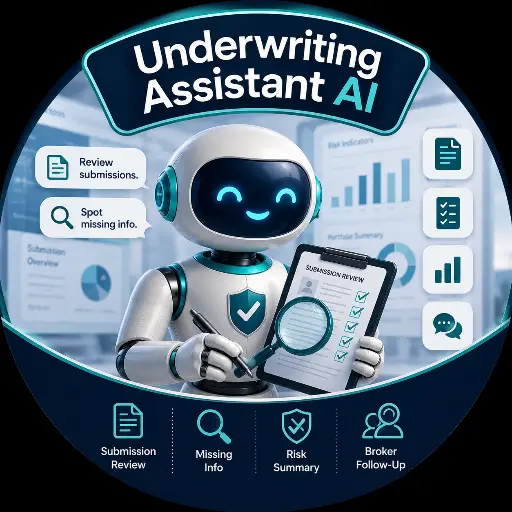
Underwriting Assistant AI
A completed internal-assistant prototype that organizes fictional commercial submissions, identifies information gaps, and prepares underwriter-ready notes without replacing underwriting authority.
Prototype statusCompleted independent prototype
Problem framing
Start with the workflow—not the technology.
The business and user challenge
Commercial submissions can arrive with scattered, incomplete, or unclear information. Review preparation becomes slower when professionals must first organize facts, identify gaps, and draft follow-up questions before applying underwriting judgment.
What the prototype is designed to test
If an assistant consistently separates known, missing, and unclear information and prepares structured follow-up questions, underwriters can spend less time organizing submissions and more time applying professional judgment.
What is known—and what is not
The prototype is grounded in commercial-underwriting workflow knowledge and a fictional small-business submission. Direct pilot research with underwriting users remains a required step before enterprise implementation.
A realistic workflow moment
A fictional mobile-cleaning company provides revenue, employee, vehicle, and loss information, but key details such as VINs, locations, limits, and prior-loss context are incomplete.
Product flow
From user need to a structured human handoff.
The workflow is intentionally visible so recruiters and product teams can see how the experience is designed—not only the final output.
- 01
Receive the submission
Organize fictional business, operations, exposure, vehicle, employee, and loss information supplied for review.
- 02
Classify information status
Separate known facts from missing, unclear, inconsistent, or unsupported information.
- 03
Prepare risk review
Surface considerations for professional review without interpreting them as an automated eligibility or pricing decision.
- 04
Draft follow-up
Create broker questions tied to the specific information gaps found in the submission.
- 05
Hand off to the underwriter
Produce organized notes that support review while keeping all authority with the authorized underwriter.
Product artifact
Known, missing, and unclear—before underwriting judgment.
This privacy-safe artifact demonstrates the review structure using the fictional Peachtree Mobile Cleaning LLC scenario built for the prototype.
Business snapshot
Reported revenue: $285,000 · Employees: 6 · Business vehicles: 3.
Loss information
Two prior auto losses are disclosed for professional review.
Submission gaps
Vehicle identification numbers, garaging addresses, requested limits, and additional loss context require follow-up.
Underwriter review
Risk considerations and broker questions are organized without approving, declining, pricing, quoting, or binding coverage.
Fictional portfolio scenario only. No employer, customer, broker, policy, or production-system information is used.
AI and technical approach
Technical fluency that turns business needs into buildable product decisions.
These decisions show how I translate business needs into a buildable AI product concept, including the workflow, information structure, human review, and integration considerations.
Privacy-safe Custom GPT
The public demonstration uses fictional data and does not reproduce proprietary employer systems, rules, or submission workflows.
Source-aware fact organization
Instructions distinguish supplied information from assumptions and require gaps or uncertainty to remain visible.
Review-ready internal notes
The output includes a submission summary, missing information, risk considerations, broker questions, and a human-review reminder.
Controlled integration requirements
Any enterprise version would require approved data sources, permissions, audit trails, monitoring, and clear override behavior.
Technical and product constraints
What the current prototype does not claim.
- The portfolio demonstration uses fictional data only.
- No connection to policy, rating, document-management, broker, or underwriting systems.
- No automated approval, decline, price, quote, bind, or eligibility decision.
- Controlled sources, access management, logging, and governance would be required before enterprise use.
Product leadership
The decisions and tradeoffs I owned.
Decision preparation—not decision automation
I framed the assistant around organization and follow-up so professional judgment remains the center of the workflow.
Make uncertainty visible
I required the output to separate known, missing, and unclear information instead of presenting a falsely complete submission.
Design for an internal handoff
I prioritized a structured note format that an underwriter can review, edit, and override.
Validation
Evidence today. Questions for the pilot.
The completed prototype demonstrates the target workflow, fictional sample submission, structured outputs, and decision boundaries. It has not been presented as a deployed underwriting system.
- Fictional commercial submission and review scenario created
- Known, missing, and unclear classification designed
- Broker follow-up and underwriter-note outputs structured
- Human authority and prohibited decisions explicitly defined
- Review-time change in a controlled pilot
- Information-gap detection quality
- Source-grounding reliability and override behavior
- Underwriter trust, usefulness, and adoption
Pilot success measures
How I would measure value responsibly.
These are proposed measures for a future controlled pilot—not results the independent prototype has already achieved.
Review-preparation time
Measure whether the assistant reduces time spent organizing a submission before judgment begins.
Information-gap detection
Assess how consistently the workflow identifies missing or unclear submission details.
Human override rate
Understand where the assistant’s organization or follow-up suggestions require correction.
Underwriter usefulness score
Evaluate whether the output supports—not distracts from—professional review.
A structured submission review with known facts, information gaps, risk considerations, broker follow-up questions, and underwriter-ready notes.
Supports more consistent review preparation while protecting the underwriter’s authority to interpret information and make decisions.
Reflection
What I learned.
The strongest internal AI products clarify where the system stops. Making uncertainty, source limits, and human authority visible creates more trust than presenting a polished but overconfident answer.
Explore the product
See the workflow in action.
The live agent is an independent portfolio demonstration using fictional or user-supplied sample information.